

 11
11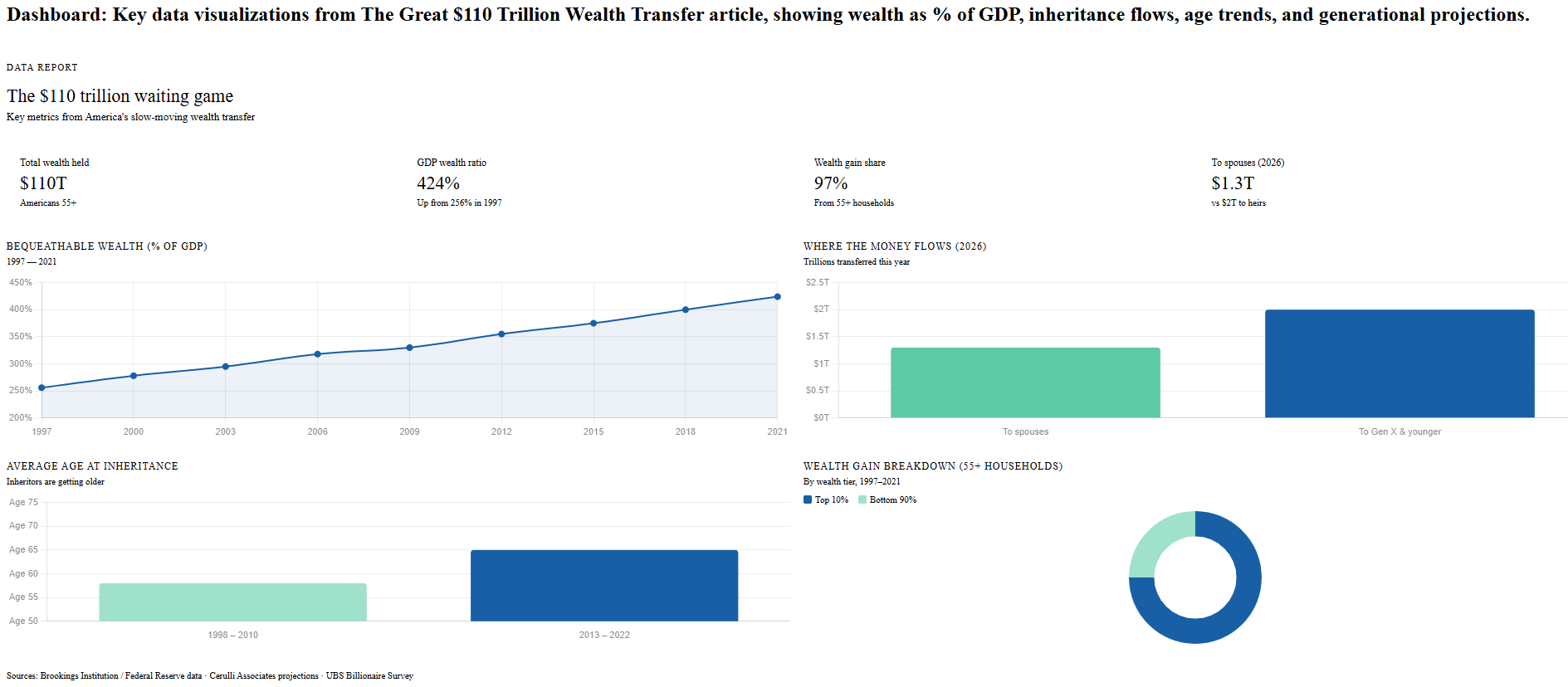
WASHINGTON — For years, financial planners and wealth management firms have been buzzing about a monumental shift on the horizon — a sweeping generational handover of wealth so massive it has been dubbed “The Great Wealth Transfer.” The numbers sound breathtaking: older Americans are collectively sitting on roughly $110 trillion in assets. But here is what nobody is telling you — do not hold your breath waiting for that check to arrive.
The reality, according to economists and financial researchers, is far less dramatic than the headlines suggest. What the industry has been selling as an incoming tidal wave may turn out to be nothing more than a slow, steady drip stretching across several decades.
The two generations currently commanding the lion’s share of American wealth are the Baby Boomers, now aged between 61 and 80, and Generation X, ranging from 45 to 61 years old. Together, they form the most financially dominant demographic block in modern American history.
And they are not going anywhere fast.
Medical advances, premium healthcare, and a booming longevity industry are extending life expectancy at an unprecedented rate — particularly among the wealthy. Research led by Harvard economist Raj Chetty confirms that the wealthiest one percent of Americans are living well into their late eighties on average, significantly outlasting lower-income peers.
Billionaires, in particular, are betting big on living longer. A recent survey conducted by UBS of 87 of its billionaire clients revealed that a majority now expect to surpass the life expectancy projections they held just a decade ago.
Meanwhile, wealthy older Americans are not exactly sitting still. Luxury travel, high-end retirement communities, and premium long-term care are consuming significant portions of their fortunes. Many are also quietly distributing smaller sums during their lifetimes — helping children and grandchildren cover home down payments, college tuitions, and family vacations.
When death does eventually come, economists point out, the money will frequently pass first to a surviving spouse — often someone of the same generation — rather than jumping straight to younger heirs.
Research firm Cerulli Associates projects that in the current year alone, approximately $1.3 trillion will transfer between spouses, while roughly $2 trillion will flow to Gen X and younger generations combined.
Brookings Institution economist and former Federal Reserve official John Sabelhaus, who has spent years studying American wealth patterns, puts it plainly.
“There is no world in which a great wealth transfer does not happen. It is just math,” he acknowledged — before adding the critical caveat: “But there is a world in which it is completely misunderstood.”
His research, drawing on Federal Reserve data, reveals a striking picture. The proportion of transferable household wealth relative to the overall economy surged from 256% of GDP in 1997 to a staggering 424% by 2021. Nearly all of that increase — a remarkable 97% — was driven by households where the primary earner was aged 55 or older. The wealthiest ten percent of that age group alone accounted for roughly three quarters of the total gain.
Perhaps the most sobering reality check in all of this is the timeline. Financial industry analysts have long marketed Millennials as the next great wealth opportunity. The data suggests otherwise.
“Everyone speaks about money going to Millennials and how they represent the next great opportunity. I think that is pretty far off,” said Chayce Horton, Associate Director at Cerulli Associates.
According to Cerulli’s projections, it is actually Generation X that stands to collect the largest inheritance over the next 12 years — a demographic that has spent decades being overlooked between the cultural dominance of Boomers and Millennials.
Last year marked an interesting turning point, with both Boomers and Millennials inheriting roughly equivalent sums from their own elderly parents. But the era of peak inheritance for Millennials remains a distant reality.
For ordinary Americans of modest means, the conversation is largely irrelevant. A significant portion of the population will inherit nothing at all, as wealth concentration continues to favor those already near the top of the economic ladder.
The great wealth transfer is real. It is inevitable. But it is also slower, more complicated, and far less evenly distributed than the financial world would have you believe.
As one economist put it — it is not a revolution. It is a waiting game.
— Reporting draws on research from the Brookings Institution, Cerulli Associates, Federal Reserve data, and UBS wealth surveys.